
Multi-Frequency vs Single-Frequency Metal Detectors: Which One Is Right for You?
- Jason Deng

- 16 hours ago
- 4 min read
Published by Quest Metal Detectors
TL;DR: Multi-frequency detectors win for most people — especially anyone hunting saltwater beaches — because they deliver depth and small-target sensitivity at once and cancel out salt noise. Single-frequency machines are cheaper, lighter, and simpler, and still excel in a few specialized cases. Hunt varied ground or the beach? Go multi-frequency. Want to skip to a proven one? See the Quest S Series →
Should you get a single-frequency machine or a multi-frequency one? It is one of the most important choices a buyer makes, and the wrong answer means missed targets, more junk digging, and a frustrating day in the field. Here's how the two differ, where each shines, and how to pick the right one for the way you hunt.
The Short Answer
For most people — especially beach and saltwater hunters — multi-frequency is the more versatile, forgiving choice. A single-frequency detector is still excellent (often lighter and cheaper) and wins in a few specialized situations. But if you want one machine that adapts to almost any ground without fiddling, multi-frequency is the way to go.
Here's why — so you can decide with confidence rather than taking our word for it.
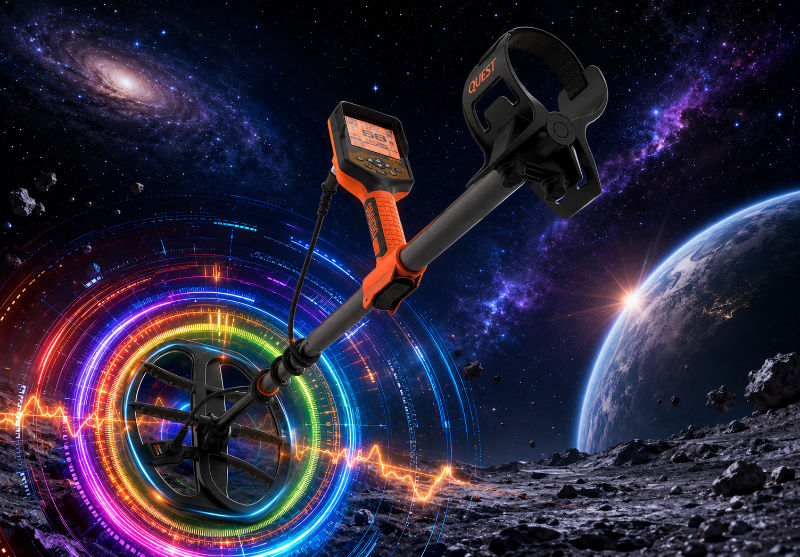
What "Frequency" Actually Means
A detector's frequency (in kHz) decides what it's best at finding — and it's always a trade-off. Every detector sends an electromagnetic signal into the ground through its coil, pulsing at a certain rate. That rate is the operating frequency, and it sets the rules:
Lower frequencies (around 5 kHz) push deeper and respond best to large, high-conductivity targets like silver coins and copper.
Higher frequencies (15–20 kHz and up) are more sensitive to small, low-conductivity targets like thin gold, tiny jewelry, and fine chains.
A single-frequency detector transmits at just one rate at a time — so it's always tuned for depth or small-target sensitivity, never fully both.
How Single-Frequency Detectors Work
One frequency, one job — done cleanly, but always with a compromise.
Strengths:
Simplicity. Fewer settings, a gentler learning curve, predictable behavior. Easier for beginners.
Weight and price. Usually lighter on the arm and easier on the wallet.
Specialized performance. A low frequency squeezes max depth from high-conductivity targets in clean soil; a high frequency makes a great gold specialist.
Limitations:
One trade-off, always. Tuned for depth means less sensitivity to tiny gold, and vice versa.
Saltwater struggles. The big one. On a wet salt beach, a single frequency often can't separate the salt signal from your target — leading to constant falsing, chatter, and missed finds.
How Multi-Frequency Detectors Work
They transmit several frequencies at once — so you stop choosing between depth and sensitivity. Instead of switching frequencies, the detector reads across the spectrum simultaneously and combines the data.
This is exactly the principle behind Quest's SimultiQ technology. Rather than switching back and forth, a SimultiQ detector processes several frequencies at once, then merges that data into a single, stable, accurate read on every target.
Want the deeper science of how simultaneous multi-frequency processing actually works? We break it down in plain English in the Quest Detecting Academy — it's the first topic we cover, and the best place to truly understand what's happening under your coil.
Why this matters in the real world:
It handles saltwater with ease. Multiple frequencies let the detector cancel the salt signal while still hearing your target — turning the most frustrating environment for single-frequency machines into a productive hunt.
Depth and sensitivity together. Good depth on big silver and strong response to small gold in the same sweep, without changing a setting.
Better target ID across mixed ground. More frequencies means more data, which means more reliable target identification and less time digging trash.
One machine for every site. Parks on Saturday, the beach on Sunday, a mineralized field next week — the same detector adapts to all of it.
So, Which Should You Choose?
Choose single-frequency if:
You are on a tight budget and hunting mostly dry land (parks, fields, woods).
You want the lightest, simplest possible machine to learn on.
You hunt one very specific target type in clean soil and want a specialist.
Choose multi-frequency if:
You want to hunt the beach and saltwater — this alone is reason enough.
You hunt varied terrain and don't want to own multiple detectors.
You want the best all-around target ID and depth without constant adjusting.
You want a machine that grows with you from beginner to experienced.
For most detectorists — especially anyone drawn to beach and water hunting — multi-frequency simply removes the compromises. That is why it has become the technology serious hunters reach for.
Experience SimultiQ for Yourself
Quest built the S Series with SimultiQ technology to deliver everything described here: simultaneous multi-frequency processing, rock-solid target ID, real depth, and confident performance from the park to underwater. It is multi-frequency done right — powerful enough for veterans, approachable enough for your very first hunt.
Ready to stop compromising between depth and sensitivity? Explore the Quest S Series →
And if you want to go deeper on the technology first, start with the Quest Detecting Academy, where we explain multi-frequency detection from the ground up.
Quest Metal Detectors — Find Impossible.


The article on Valhalla Vitality about enclomiphene and water retention gives a useful overview of how hormonal changes may affect the body. It highlights that individual responses can vary significantly. I like that the article focuses on realistic expectations instead of exaggerated claims. The content is easy to understand and informative. Worth reading if you're exploring this topic.
https://valhallavitality.com/blog/understanding-how-enclomiphene-can-cause-water-retention